For many years, manufacturers viewed cybersecurity as an IT issue, something that affected office computers, email accounts, and company websites. The production floor was a different world.
Today, that distinction no longer exists. Modern manufacturing depends on technology at almost every stage of production: machines are connected to networks, inventory is managed through software, suppliers exchange information digitally, and employees rely on cloud applications to keep operations moving.
The more connected a manufacturing business becomes, the more opportunities cybercriminals have to disrupt it. Unlike many other industries, manufacturers don’t just lose data during a cyberattack:
- They can lose production time.
- Miss delivery deadlines.
- Interrupt supply chains.
- And in some cases, bring an entire facility to a standstill.
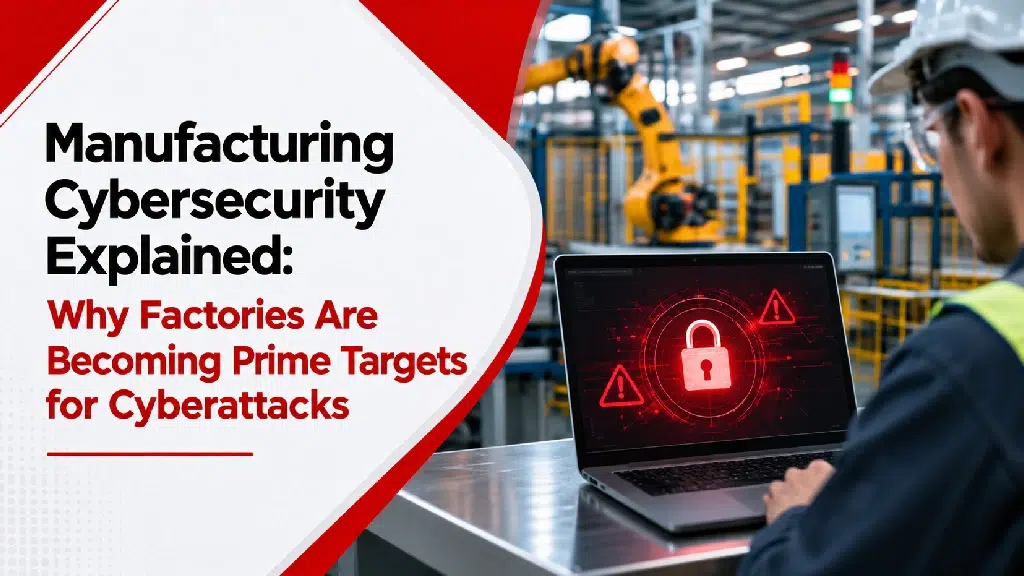
That’s why manufacturing cybersecurity isn’t simply about protecting computers it’s about protecting the business’s ability to operate.
Why Manufacturers Are Being Targeted More Often
Manufacturing companies have become attractive targets for several reasons:
Continuous production demands:
Many facilities depend on continuous production where every hour of downtime costs money. Cybercriminals know this. If production stops, businesses often feel pressure to recover quickly, which can make threats like ransomware attacks particularly damaging to operational continuity.
Complex supply ecosystems:
Manufacturers frequently work with suppliers, distributors, logistics providers, and customers through connected systems. Each connection creates another potential entry point if it isn’t properly secured. Implementing a dedicated manufacturing cybersecurity strategy ensures that data shared across these networks is continuously protected.
Technology disparity:
Many manufacturers still operate a mix of modern and legacy technology. Older equipment may still perform its production role perfectly, but wasn’t designed with today’s cybersecurity threats in mind.
It’s No Longer Just About Office Computers
When people think about cybersecurity, they often picture laptops and email accounts. In manufacturing, the picture is much bigger. A typical environment may include:
- Production equipment
- Industrial control systems
- Warehouse technology
- Barcode scanners
- Engineering workstations
- ERP software
- Cloud platforms
- Employee laptops and mobile devices
All of these systems contribute to daily operations. Protecting only one part of the environment leaves other areas exposed. Plant managers often turn to specialized manufacturing IT services to bridge the security gap between operational technology (OT) and office IT infrastructure.
Downtime Is Often the Biggest Cost
If an office computer stops working, one employee may lose productivity. If a manufacturing system becomes unavailable, an entire production line may stop. That can lead to:
- Delayed shipments
- Missed production targets
- Overtime costs
- Disrupted customer schedules
- Supply chain delays
The financial impact of downtime often exceeds the cost of recovering the affected systems. Discovering how managed IT prevents downtime can help plant leaders shift from reactive fire-fighting to proactive operational stability.
Employees Still Play a Critical Role
Not every cybersecurity incident begins with sophisticated hacking; many begin with ordinary mistakes:
- An employee opens a suspicious attachment.
- A weak password is reused across multiple accounts.
- Someone connects an unauthorized device to the company network.
Technology helps reduce risk, but employee awareness remains one of the strongest security controls a business can have. Training staff to avoid the most common cybersecurity mistakes employees make helps teams recognise and neutralize phishing attempts before they evolve into full plant shutdowns.
Older Equipment Creates Unique Challenges
Many manufacturers continue using equipment that’s been in service for years. Replacing production machinery isn’t always practical or necessary. The challenge is that older systems may:
- No longer receive security updates
- Rely on outdated operating systems
- Support limited security features
That doesn’t automatically mean they must be replaced. Instead, businesses often look at ways to isolate and protect older equipment while planning for future modernization with experienced IT services providers who understand OT network segmentation.
Backups Matter More Than Most Businesses Realize
Imagine arriving at work to discover that critical production data has become inaccessible. How quickly could operations recover?
Reliable backups are one of the most effective ways to reduce the impact of unexpected incidents. Just as importantly, those backups should be tested regularly. A backup that cannot be restored isn’t much of a backup at all.
Remote Access Needs Careful Management
Manufacturers increasingly rely on remote access for:
- Engineers
- Equipment vendors
- IT providers
- Management teams
Remote connectivity improves efficiency, but it also expands the number of ways systems can be accessed. Deploying modern managed IT services for manufacturing ensures that vendor portals and third-party remote diagnostics are locked down with strict zero-trust access controls and multi-factor authentication.
Cybersecurity Is Also About Business Continuity
A strong cybersecurity strategy isn’t only about stopping attacks. It’s about ensuring the business can continue operating if something unexpected happens. That includes planning for:
- System failures
- Ransomware incidents
- Internet outages
- Hardware failures
- Natural disasters
Adopting comprehensive cybersecurity services paired with active managed detection and response (MDR) guarantees that anomalies are quarantined in minutes, keeping facility operations safe.
Questions Every Manufacturer Should Be Asking
Cybersecurity isn’t just an IT discussion anymore; it’s a business discussion. Leaders should periodically ask questions such as:
- Could production continue if one critical system failed?
- Are backups tested regularly?
- Do employees receive cybersecurity training?
- Are older systems adequately protected?
- How quickly could operations recover after an incident?
The answers often reveal opportunities for improvement long before problems occur. Evaluating these questions using a clear cybersecurity checklist for businesses gives decision-makers an actionable roadmap.
Cybersecurity Is an Ongoing Process
There’s no point where a manufacturer becomes “finished” with cybersecurity. Technology changes, production evolves, and threats continue to develop.
Regular reviews, employee awareness, infrastructure updates, and security assessments all play a role in maintaining a resilient operation. Knowing how often companies should conduct security audits helps management verify regulatory compliance and maintain eligibility for commercial cyber insurance.
Final Thoughts
Manufacturing has become more connected than ever before. That connectivity creates enormous opportunities for efficiency, automation, and growth it also creates new risks that businesses can’t afford to ignore.
A successful cybersecurity strategy doesn’t just protect data. It protects production schedules, customer relationships, employee productivity, and the long-term stability of the business.
Partnering with a proven technology partner like Sierra Experts empowers manufacturing facilities to modernize their infrastructure while protecting critical shop-floor operations from emerging cyber threats. If you are ready to evaluate your operational risk, contact us today for a plant-floor security assessment.
Frequently Asked Questions
Why are manufacturers targeted by cybercriminals?
Manufacturers often rely on continuous operations, making downtime expensive. This can make them attractive targets for ransomware and other cyberattacks.
What are the biggest cybersecurity risks in manufacturing?
Common risks include ransomware, phishing attacks, outdated systems, unsecured remote access, and production downtime caused by technology failures.
Do manufacturers need cybersecurity if they already have antivirus software?
Yes. Antivirus is only one layer of protection. Modern cybersecurity also includes employee training, backups, access controls, network security, monitoring, and incident response planning.
How can manufacturers reduce cybersecurity risks?
Regular security assessments, strong authentication, employee awareness training, reliable backups, and proactive monitoring all help reduce risk.
Why is downtime such a concern for manufacturers?
Unlike many businesses, manufacturers can lose production capacity, delay shipments, and interrupt supply chains when critical systems become unavailable.