
IT Due Diligence Checklist for Private Equity: What Investors Should Review Before an Acquisition
Financial due diligence tells you what a business has achieved. IT due diligence tells you whether the business can continue achieving it. That’s an important distinction.
Two companies can have similar revenue, similar margins, and similar growth projections while carrying very different technology risks. One may have modern systems, documented processes, and strong cybersecurity. The other may depend on aging servers, unsupported software, shared administrator passwords, and one employee who “knows how everything works.”
Those risks don’t always appear on a balance sheet, but they often become expensive after the acquisition closes.
Technology now plays a role in almost every part of a business—from sales and operations to customer service and finance. Understanding the condition of that technology helps investors identify hidden costs, operational risks, and opportunities for improvement.
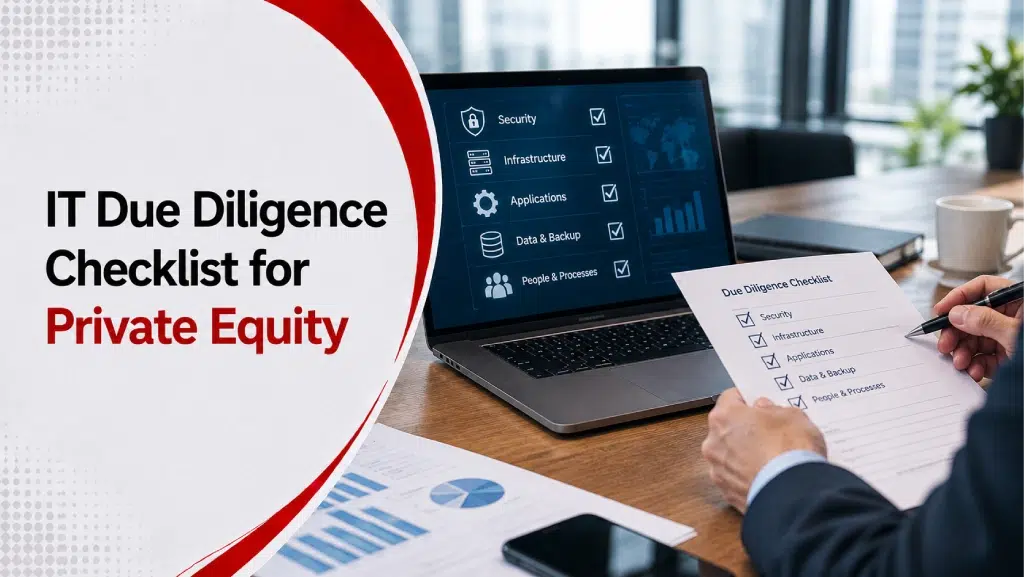
Whether you’re acquiring a manufacturing company, healthcare provider, professional services firm, or multi-location business, here is the complete checklist worth reviewing before the deal is complete.
1. Start With the Business Context
A common mistake during IT due diligence is jumping straight into hardware inventories. Servers matter. Networks matter. But the first question should be much simpler: how does technology support the business?
Understanding how employees work makes it easier to identify which systems are business-critical and which can be modernized later.
Key Questions to Answer:
- Which applications directly generate revenue?
- Which systems would immediately stop operations if they failed?
- Which departments rely most heavily on specialized technology?
Without that context, it’s difficult to judge technical risk accurately.
2. Review the Existing Infrastructure
Cybersecurity has become one of the most important parts of IT due diligence. Weak security reduces valuation and increases operational risk long after the acquisition is complete. Evaluating proactive cybersecurity services and protocols early prevents costly liabilities down the road.
Infrastructure Checklist:
- On-premise servers (age, warranty, and lifecycle)
- Networking equipment (routers, firewalls, and switches)
- Wireless infrastructure and coverage
- Primary and secondary internet connectivity
- Backup power systems and hardware redundancy
- Cloud services, hosting environments, and current utilization
3. Assess Cybersecurity Maturity
Cybersecurity has become one of the most important parts of IT due diligence. Weak security reduces valuation and increases operational risk long after the acquisition is complete.
Cybersecurity Checklist:
- Is multi-factor authentication (MFA) enforced across all systems?
- Are modern endpoint protection (EDR/XDR) tools deployed?
- Are systems and software regularly patched and updated?
- Is regular employee security awareness training provided?
- Are backups isolated, immutable, and regularly tested?
- Is there a tested, documented incident response plan?
4. Understand Software Dependencies and Licensing
Many businesses rely on software that has evolved over years. Some applications are well documented, while others depend heavily on one employee or one vendor. Evaluating the balance of custom software vs. off-the-shelf software across the organization helps clarify maintainability, licensing overhead, and true operational costs.
Software Checklist:
- Inventory of business-critical applications and ERPs
- Identification of legacy or unsupported software
- Software licensing compliance and potential true-up costs
- Proprietary or custom applications (code ownership, maintainability)
- Critical third-party SaaS and vendor dependencies
5. Review Documentation and Access Controls
Documentation often receives very little attention until something breaks. Well-documented environments are generally easier to support, secure, and integrate after an acquisition.
Documentation Checklist:
- Complete, up-to-date network and architecture diagrams
- Centralized management of administrator accounts and credentials
- Hardware and asset inventories
- Software licenses, keys, and subscription records
- Standard operating and backup procedures
- Complete vendor contracts and emergency support contacts
6. Evaluate Disaster Recovery and Business Continuity
Every business experiences disruptions eventually. The question is whether it’s prepared. A robust backup and disaster recovery plan isn’t valuable simply because it exists—it’s valuable because the business knows it will work under pressure.
Disaster Recovery Checklist:
- Backup frequency and retention policies
- Recovery Time Objectives (RTO) and Recovery Point Objectives (RPO)
- Documented schedule of real-world recovery testing
- Internet, power, and telecommunications redundancy
- Crisis communication and business continuity plans
7. Examine IT Operations and Support
Technology isn’t only about equipment; it’s also about processes. Partnering with experienced managed IT services often provides the structure, scalability, and standardized support workflows that growing portfolio companies lack.
Operational Checklist:
- Ticketing process and support request response times
- Patch management workflows and cadence
- IT procurement and technology purchase approval chains
- Employee onboarding and offboarding security workflows
- Clearly defined internal roles and vendor responsibilities
8. Identify Key Person Risk
Many growing businesses depend heavily on one individual. Sometimes it’s an internal employee; sometimes it’s an outside consultant. If that person disappeared tomorrow, could someone else manage the environment?
Reducing key person risk is an important objective after acquisition, but identifying it during due diligence is even more valuable.
9. Plan for Post-Acquisition Integration
Technology decisions shouldn’t stop at acquisition. Think about what happens afterwards. Planning integration early often reduces costs later. Specialized private equity IT services can help bridge the gap between pre-close assessment and post-merger technology harmonization.
Integration Considerations:
- Can systems integrate cleanly with existing portfolio companies?
- Will email, communication, and identity platforms need to be standardized?
- Are cloud environments and ERPs compatible?
- Can operational and financial reporting be centralized?
10. Look Beyond Immediate Risks: Value Creation
IT due diligence isn’t only about finding problems. It’s also about identifying opportunities.
Modernizing infrastructure, improving cybersecurity, automating workflows, or migrating to cloud platforms may all create operational improvements after acquisition. Sometimes technology becomes one of the fastest ways to increase efficiency and enterprise value across the business.
Final Thoughts
Technology rarely determines whether an acquisition happens. But it often determines how smoothly the business performs after the acquisition is complete.
Strong IT due diligence helps investors understand not only today’s technology environment, but also the investment required to support future growth. By evaluating infrastructure, cybersecurity, documentation, operational processes, and long-term scalability, private equity firms can make more informed decisions and reduce the likelihood of unexpected technology surprises after closing.
Whether assessing a regional business in Pittsburgh or managing a multi-state rollout, partnering with a trusted IT provider like Sierra Experts can streamline evaluation and post-close transition. If your firm is evaluating a potential deal, contact our team to conduct a comprehensive IT due diligence audit.
Frequently Asked Questions
What is IT due diligence?
IT due diligence is the process of evaluating a company’s technology, cybersecurity, infrastructure, software, and operational processes before an acquisition or investment.
Why is IT due diligence important for private equity?
It helps identify technology risks, future investment requirements, cybersecurity concerns, and operational issues that may affect the value of an acquisition.
What should be included in an IT due diligence review?
Typical areas include infrastructure, cybersecurity, software, licensing, documentation, disaster recovery, compliance, and IT operations.
How does cybersecurity affect acquisitions?
Weak cybersecurity can increase financial, legal, and operational risk after an acquisition, making it an important area to assess during due diligence.
Should IT due diligence include future technology planning?
Yes. Understanding future infrastructure, integration, and modernization requirements helps investors estimate post-acquisition costs and opportunities.
Related Posts
Technology Risks During Business Expansion (And How to Avoid Them)
Growth is usually measured by numbers: More customers More employees More revenue More locations What often goes unnoticed is that every stage of growth also
How to Standardize Technology Across Multiple Office Locations
Expansion is rarely a perfectly planned process. A business opens a second office because demand increases, another location is acquired, or a regional team starts
Secure IT for Growing Companies: Building a Foundation That Scales
Growth changes more than revenue; it changes the way a business uses technology. A company with ten employees can often get by with a fairly

IT Budget Planning for Small and Mid-Sized Businesses: A Smarter Way to Invest in Technology
For many businesses, the IT budget isn’t really a budget; it’s a series of unexpected expenses: A server fails. Several laptops need to be replaced