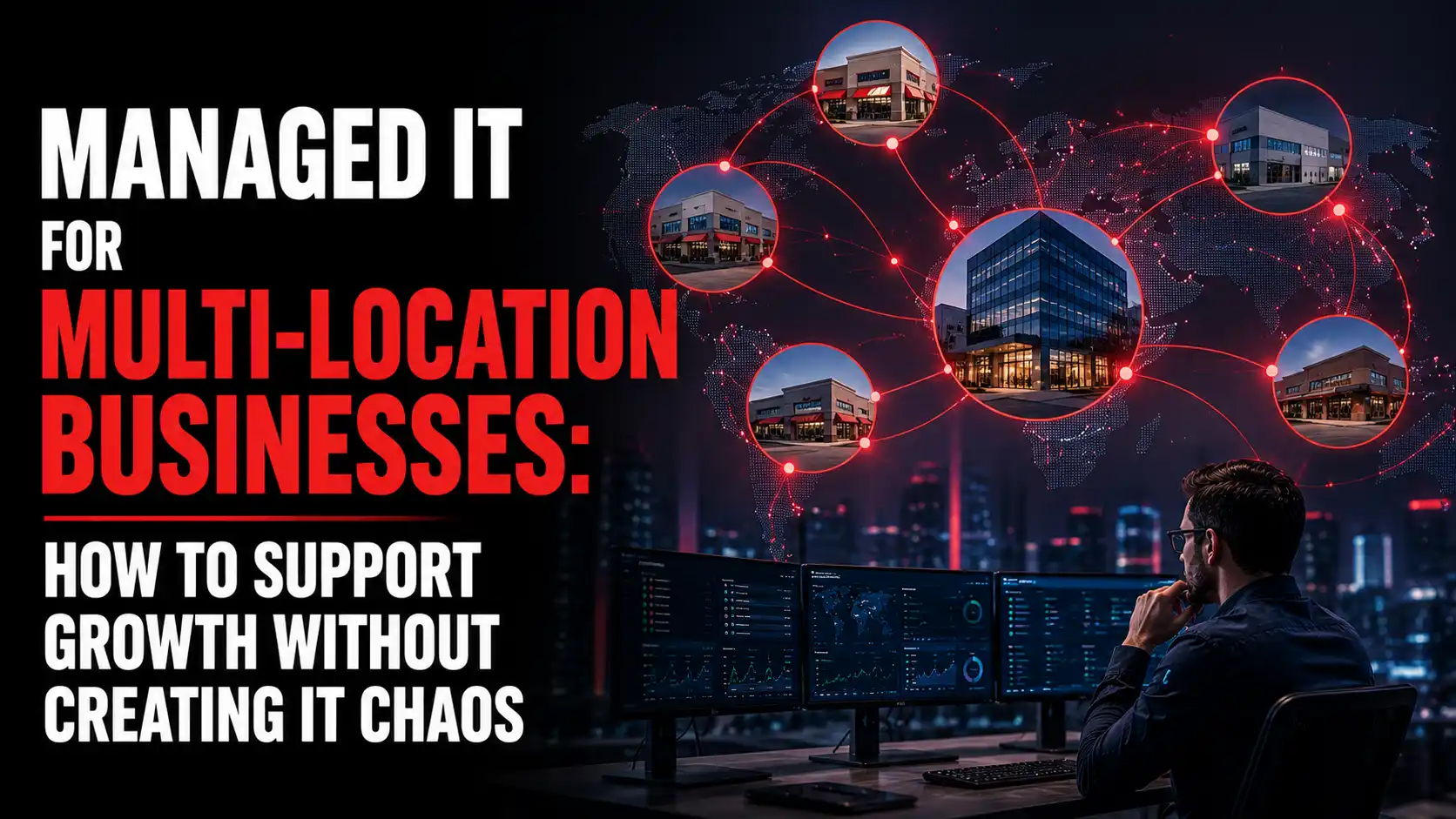
Opening a second office sounds exciting.
By the third or fourth location, technology starts becoming more complicated.
Employees expect the same experience everywhere.
Leadership expects visibility.
Operations expect consistency.
Customers expect reliability.
But behind the scenes, multi-location businesses often face an entirely different reality.
Different internet providers. Different devices. Different support processes. Different security settings.
Over time, technology becomes fragmented.
That is why many growing organizations move toward managed IT models built specifically for multi-location environments.
This guide explains how managed IT supports businesses operating across multiple locations and what leaders should think about before expanding further.
What Counts as a Multi-Location Business?
A multi-location business operates from more than one physical location while maintaining shared systems, operations, or services.
Examples include:
- Regional offices
- Healthcare practices
- Manufacturing facilities
- Professional service firms
- Retail operations
- Warehouses
- Franchise-style operations
- Hybrid office environments
The challenge is rarely opening locations.
The challenge is supporting them consistently.
Businesses evaluating centralized IT support structures can also review what managed IT services include to better understand how ongoing support scales across locations.
Why IT Gets More Complex as Businesses Expand
Growth usually increases technology complexity faster than expected.
Each new location often introduces:
- New users
- More devices
- Additional vendors
- More internet dependencies
- Expanded security requirements
- More support requests
Without a centralized approach, every office starts operating differently.
That creates operational risk.
Common IT Challenges Multi-Location Businesses Face
Before discussing solutions, it helps to understand the typical problems.
Inconsistent Employee Experience
Employees may experience:
- Different login processes
- Different software versions
- Different support quality
- Different collaboration experiences
Employees should not need different instructions depending on location.
Support Delays Across Locations
Internal teams often struggle to support geographically distributed employees.
Common issues include:
- Limited onsite coverage
- Delayed troubleshooting
- Time zone coordination
- Communication gaps
As locations increase, support expectations rise.
Security Becomes Harder to Standardize
Multiple offices create additional security exposure.
Challenges often include:
- Device inconsistency
- Access control gaps
- Shared credentials
- Different security practices
Security becomes difficult when environments evolve independently.
Infrastructure Visibility Declines
Leadership often asks:
- Which locations create the most tickets?
- Which offices experience outages?
- What equipment needs replacement?
Without centralized visibility, answers become difficult.
Organizations experiencing operational strain during expansion may also notice several reasons businesses switch IT providers, especially when support models no longer scale effectively.
What Managed IT Looks Like for Multi-Location Businesses
Managed IT helps create one operational model across locations.
Instead of every office operating independently, technology becomes standardized and centrally supported.
1. Centralized Support Across Locations
Employees receive one support experience regardless of location.
Typical features include:
- Central help desk
- Ticket management
- Remote troubleshooting
- Escalation procedures
- Consistent communication
Employees know exactly where to go for help.
2. Standardized Device Management
Device inconsistency creates support complexity.
Managed environments typically standardize:
- Device provisioning
- Operating systems
- Security policies
- Software deployment
- Lifecycle management
Consistency improves reliability.
3. Centralized Monitoring and Visibility
Managed IT provides visibility across environments.
Typical monitoring includes:
- Devices
- Servers
- Networks
- Cloud environments
- Performance metrics
Leadership gains better operational insight.
Questions become easier to answer:
- Which location needs attention?
- Where is downtime increasing?
- Which systems require upgrades?
Businesses focused on improving operational stability across offices can also explore how managed IT prevents downtime through proactive monitoring and maintenance.
4. Unified Security Policies
Security should not depend on office location.
Managed IT often helps standardize:
- Multi-factor authentication
- Device controls
- Access permissions
- Monitoring
- Endpoint protection
- Backup requirements
This reduces variation and lowers operational risk.
5. Cloud-Based Collaboration and Administration
Cloud platforms help reduce geographic barriers.
Managed environments often support:
- Microsoft 365
- Teams
- SharePoint
- Cloud storage
- Identity systems
- Centralized administration
Employees collaborate more easily across offices.
Businesses planning broader cloud adoption can also learn how to migrate to Microsoft 365 without downtime while maintaining operational continuity.
6. Vendor Coordination Across Locations
Multiple locations often mean multiple vendors.
Examples:
- Internet providers
- Telecom vendors
- Software providers
- Hardware suppliers
Managed IT can centralize communication and issue resolution.
7. Scalable Onboarding and Offboarding
Employee changes become more frequent as businesses grow.
Managed environments often standardize:
Onboarding
- Device preparation
- Access setup
- Security controls
Offboarding
- Access removal
- Device recovery
- Documentation updates
Consistency reduces administrative burden.
8. Better Planning for Growth
Multi-location expansion creates long-term decisions.
Examples include:
- Infrastructure investments
- Cloud adoption
- Security improvements
- Support scaling
Managed IT supports planning instead of reacting.
Businesses comparing operational support structures may also benefit from reviewing the co-managed vs fully managed IT model to determine how responsibilities should be divided internally and externally.
Signs Your Multi-Location Business May Need Managed IT
You may benefit from managed IT if:
- Locations operate differently
- Support quality varies
- Employees experience delays
- Security practices differ
- Internal IT feels overloaded
- Visibility across offices is limited
The earlier these issues are addressed, the easier growth becomes.
Managed IT Does Not Mean Losing Control
A common misconception is that managed IT reduces flexibility.
In reality, centralized support often improves governance while allowing locations to remain operationally independent.
Leadership still controls:
- Business priorities
- Technology decisions
- Growth direction
Managed support helps execute consistently.
Final Thoughts
Technology complexity grows faster than office count.
What worked for one office rarely scales automatically across multiple locations.
Managed IT helps multi-location businesses create standardized operations, centralized support, stronger security, and better visibility.
The objective is not controlling every office.
It is giving every location access to reliable systems that support growth.
Frequently Asked Questions
What is managed IT for multi-location businesses?
It is an IT support model designed to manage users, systems, security, and operations consistently across multiple locations.
Does managed IT require the same setup at every office?
Not necessarily. Standards can remain consistent while adapting to local operational needs.
Can managed IT support remote employees too?
Yes. Modern managed IT commonly supports office, hybrid, and remote work environments.
How does managed IT improve security across locations?
It standardizes policies, monitoring, access controls, and device management.
Is managed IT only for large businesses?
No. Growing businesses with two or more locations often benefit from centralized support.