A few years ago, business communication was simple.
Employees came to the office.
They answered calls from their desk phones.
Meetings happened in conference rooms.
If someone worked from home, it was usually the exception.
Today, for many businesses, it’s the opposite.
Employees split their time between the office and home.
Sales teams spend more time visiting clients than sitting at their desks.
Managers travel frequently.
Some companies don’t even have a single central office anymore.
The challenge isn’t whether employees can work remotely.
It’s whether they can communicate just as effectively outside the office as they can inside it.
That’s one of the biggest reasons businesses have adopted Voice over Internet Protocol (VoIP).
Instead of tying communication to a building, VoIP allows employees to stay connected wherever work takes them.
What Is VoIP?
VoIP, or Voice over Internet Protocol, allows businesses to make and receive phone calls using an internet connection instead of traditional telephone lines.
Employees can use:
- desk phones
- laptops
- smartphones
- tablets
- desktop applications
while keeping the same business phone number.
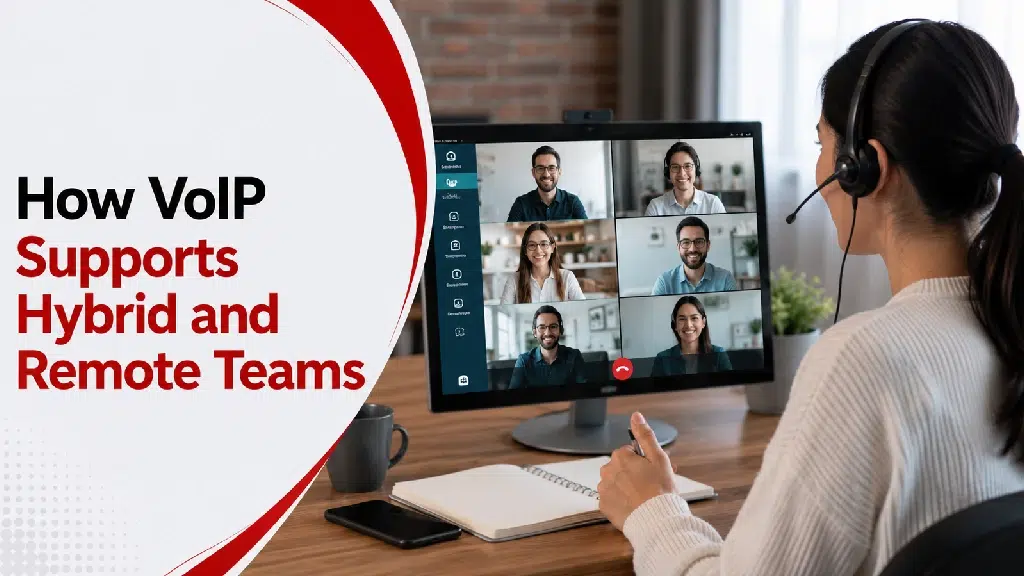
For hybrid and remote teams, adopting modern VOIP services changes how communication works.
Why Traditional Phone Systems Struggle With Hybrid Work
Traditional business phone systems were designed for a different way of working.
The assumption was simple: Employees would be in the office.
If someone wasn’t at their desk, they probably weren’t available.
That model creates challenges today. When looking at the differences between VoIP vs traditional business phones, legacy setups force remote employees to:
- forward calls to personal phones
- use separate mobile numbers
- rely on voicemail
- ask coworkers to transfer calls manually
The result is inconsistent communication and a fragmented customer experience. If you are noticing these bottlenecks, it may be one of the clear signs that your business phone system is outdated.
How VoIP Solves These Challenges
Rather than connecting calls to a physical office, VoIP connects them to employees.
Whether someone is working from headquarters, home, or an airport lounge, they can still answer calls using the same business number.
Customers don’t need to know where an employee is located.
They simply reach the right person.
Benefit #1: Employees Can Work From Anywhere
Perhaps the biggest advantage of VoIP is location independence.
Employees can answer business calls from:
- home offices
- branch locations
- hotels
- client sites
- coworking spaces
As long as they have a reliable internet connection, they can stay connected to the business phone system.
This flexibility helps businesses support remote work without sacrificing professionalism.
Benefit #2: One Business Number Across All Devices
Without VoIP, employees often end up giving customers their personal mobile numbers.
Over time, this creates confusion. Customers don’t know which number to call, employees lose privacy, and calls become harder to track.
VoIP allows employees to use one business number across multiple devices.
Whether they answer from a laptop or smartphone, the caller sees the business number—not a personal one.
Benefit #3: Easier Collaboration Between Teams
Hybrid work isn’t just about answering phone calls. Employees also need to collaborate throughout the day. Modern VoIP phone solutions often integrate with tools such as:
- Microsoft Teams
- Microsoft 365
- CRM systems
- collaboration platforms
This allows employees to:
- transfer calls
- message coworkers
- schedule meetings
- share information
without constantly switching between applications.
Benefit #4: Better Customer Experience
Customers don’t care where employees are working. They care about getting help quickly.
VoIP helps create a more consistent experience through features such as:
- auto attendants
- call forwarding
- call queues
- voicemail to email
- simultaneous ringing
Calls reach the right people even when they aren’t sitting in the office.
Benefit #5: Faster Onboarding for New Employees
Hiring remote employees used to require significant phone system changes.
Today, adding a new team member is often much simpler.
Instead of installing new phone lines, businesses can:
- create a user account
- assign a business number
- configure permissions
The employee can begin using the phone system almost immediately.
This flexibility supports business growth.
Benefit #6: Improved Business Continuity
Unexpected events happen—weather, power outages, building maintenance, or transportation disruptions. With traditional systems, these situations can interrupt business communications.
Cloud-based VoIP phone service options help reduce that risk by allowing employees to continue answering calls from other locations. Utilizing a cloud setup is an effective way to reduce communication downtime and ensure your business communication becomes less dependent on a single office.
Benefit #7: Easier Management for IT Teams
Supporting remote employees becomes much easier when communication is managed centrally. This is especially true when establishing a seamless business communication setup for multi-location companies. IT administrators can often:
- add users
- update settings
- manage permissions
- review call activity
This completely simplifies ongoing administration without requiring IT to visit individual office locations.
Common Misconceptions About VoIP
1. “VoIP Is Only for Remote Companies”
Not at all.
Many organizations with traditional offices also use VoIP because it provides greater flexibility.
2. “Employees Need Special Hardware”
Many VoIP systems work with:
- computers
- mobile apps
- existing compatible desk phones
Businesses can choose the setup that fits their needs.
3. “Remote Calls Sound Worse”
Call quality depends primarily on network quality rather than employee location. If you are noticing choppy audio, it’s usually tied to broader business call quality problems like bandwidth constraints.
With a stable business internet connection, VoIP provides excellent audio quality. However, it is always wise to review potential VoIP security risks to ensure your remote connections remain safely encrypted.
Is VoIP Right for Every Hybrid Business?
VoIP is often a strong fit for organizations that:
- support remote employees
- operate multiple offices
- expect future growth
- want centralized communication
- rely on Microsoft Teams or similar collaboration platforms
Businesses that continue expanding beyond a single office often benefit the most from exploring unified communications to pull all their tools into one dashboard.
If you’re also finding that your internal workflow software can’t keep up with this growth, it might be one of the signs your business needs custom software to run alongside your new communication tools.
Questions to Ask Before Choosing a VoIP System
Before selecting a solution, consider:
- How many employees work remotely?
- Do employees frequently travel?
- Are customers experiencing communication delays?
- Will the business continue growing?
- Do we want communication integrated with collaboration tools?
You will also likely want to calculate your budget and research how much a cloud phone system costs before making a final decision. The answers to these questions will help determine which platform best supports your operations.
Final Thoughts
Hybrid work has permanently changed how businesses communicate. Employees are no longer tied to a desk, and customers expect the same level of service regardless of where staff are working.
VoIP helps bridge that gap by giving employees secure, reliable access to business communications from virtually anywhere. More importantly, it allows businesses to deliver a consistent customer experience without being limited by physical office locations.
For organizations embracing hybrid or remote work, shifting to modern business VoIP phone services isn’t simply a replacement for traditional phone lines. It’s an essential communication platform built for the way modern teams work.
If you’re ready to upgrade your team’s infrastructure, feel free to visit the Sierra Experts website or contact us directly to build a custom solution for your business.
Frequently Asked Questions
What is VoIP?
VoIP (Voice over Internet Protocol) allows businesses to make and receive phone calls over an internet connection instead of traditional telephone lines.
Is VoIP good for remote employees?
Yes. VoIP allows employees to answer business calls from laptops, smartphones, tablets, and compatible desk phones from virtually anywhere.
Can remote employees keep the same business phone number?
Yes. One of VoIP’s key advantages is allowing employees to use the same business number across multiple devices.
Does VoIP improve collaboration?
Many VoIP platforms integrate with collaboration tools such as Microsoft Teams, making communication and teamwork more seamless.
Can VoIP help during office outages?
Yes. Because cloud-based VoIP is not tied to a single physical location, employees can often continue handling calls from alternate locations during unexpected disruptions.