
A surprising number of businesses assume their website has only two possible states:
It either works, or it needs to be replaced.
In reality, most websites fall somewhere in between.
Perhaps the design feels dated, but the content still performs well. Maybe the site looks modern, but it’s slow, difficult to update, or generating very few enquiries. In other cases, the business itself has changed so much that the current website no longer reflects what the company actually does.
The challenge is knowing whether those problems can be solved with a redesign or whether the website needs to be rebuilt from the ground up.
Although the two terms are often used interchangeably, they’re very different projects with different costs, timelines, and outcomes.
What’s the Difference?
The simplest way to think about it is this:
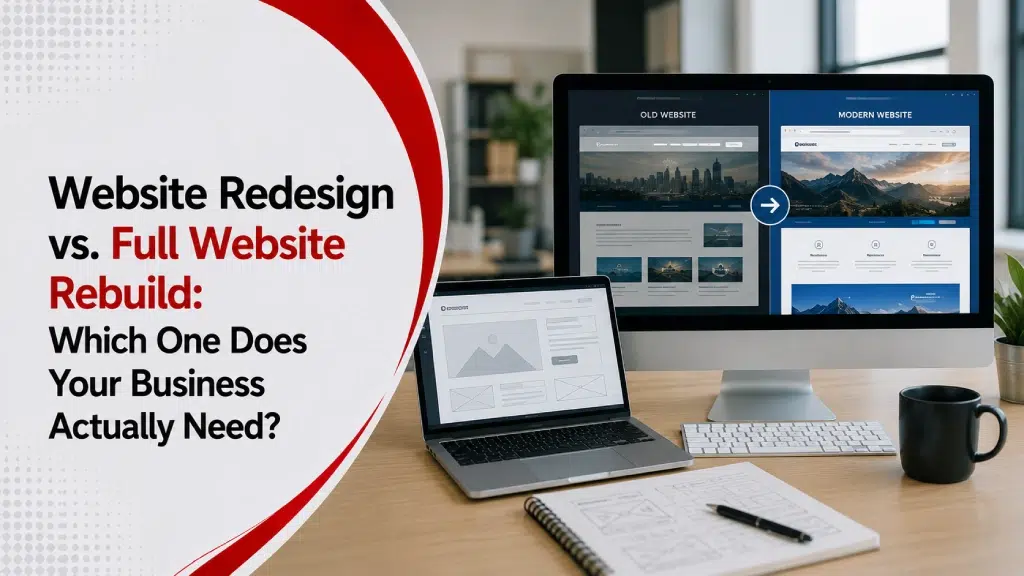
A website redesign changes how the website looks and feels.
A website rebuild changes how the website is built.
Sometimes a redesign is enough to give a business a fresh, modern online presence.
Other times, changing the design without fixing the underlying issues is a bit like renovating a house with structural problems—you might improve the appearance, but the real issues remain.
What Is a Website Redesign?
A redesign focuses primarily on the user experience and visual presentation.
Typical redesign projects include:
- updating layouts
- improving branding
- refreshing colours and typography
- reorganising pages
- improving navigation
- making the site mobile-friendly
The underlying platform often stays the same.
Think of it as renovating an office without changing the building itself.
What Is a Website Rebuild?
A rebuild goes much deeper.
Instead of changing only the appearance, developers rebuild part or all of the website’s foundation.
That may involve:
- moving to a new CMS
- replacing outdated code
- improving performance
- restructuring the database
- rebuilding templates
- adding new functionality
A rebuild is usually chosen when the existing website has technical limitations that can’t be solved with cosmetic changes alone. For projects that require complex functionality or a completely new foundation, partnering with professional website development services ensures the backend is built correctly.
When a Redesign Is Usually the Right Choice
Many businesses don’t need to start from scratch.
A redesign is often enough when:
1. Your branding has evolved
Perhaps your logo, messaging, or visual identity has changed while the website has stayed the same. A redesign helps create consistency across your holistic marketing and development efforts.
2. The website feels outdated
Design trends change over time.
A site built eight or ten years ago may still function perfectly, but it can create the wrong first impression.
Visitors often judge credibility within seconds of landing on a website.
3. Navigation has become confusing
As businesses grow, pages get added one after another.
Eventually, customers struggle to find information.
Sometimes reorganising content is more valuable than adding new pages.
4. Mobile experience needs improvement
Today, many visitors first encounter a business on their phone.
If the website is difficult to use on smaller screens, a redesign can significantly improve usability.
When a Full Rebuild Makes More Sense
Sometimes the problems are much deeper than design.
The website is slow despite optimisation
If developers have already compressed images, improved hosting, and made technical improvements but the site remains slow, the underlying architecture may be the problem.
The business has changed completely
Imagine a company that started as a local IT support provider but now offers cybersecurity, cloud infrastructure, software development, and managed services.
The existing website may no longer reflect the business.
Trying to patch it page by page often creates more complexity than rebuilding it properly.
Managing content has become frustrating
Some websites are so difficult to update that every small change requires a developer.
Modern content management systems make publishing and maintaining content much easier.
If updating your own website feels like a technical project, it may be time for a rebuild.
New functionality is becoming difficult to add
Businesses often want features such as:
- customer portals
- online booking
- integrations
- calculators
- dashboards
- secure logins
Older websites may not support these additions efficiently.
At some point, rebuilding becomes the more practical long-term solution.
SEO issues are built into the website
Sometimes poor search performance isn’t caused by content.
It may be caused by technical issues such as:
- poor site architecture
- duplicate templates
- crawlability problems
- outdated code
- weak Core Web Vitals
These issues often require more than a visual redesign. Furthermore, technical flaws and hidden vulnerabilities are primary reasons why business websites fail to generate leads effectively.
If security flaws are holding back your search rankings or user trust, running through a comprehensive website security checklist should be a top priority during the architectural overhaul.
Questions to Ask Before Making a Decision
Rather than asking, “Do we need a new website?”
Ask questions like:
- Is our website generating enquiries?
- Can customers easily find information?
- Is it easy for our team to update?
- Does it accurately represent our business today?
- Are technical limitations holding us back?
The answers usually make the right direction much clearer.
What About Cost?
A redesign is generally the smaller project because much of the existing foundation remains.
A rebuild typically requires more planning, development, testing, and migration.
However, cost alone shouldn’t determine the decision.
Choosing a redesign when the website actually needs rebuilding may simply postpone the investment while leaving the original problems unresolved.
Likewise, rebuilding a website that only needs a refreshed design can be an unnecessary expense.
The goal isn’t spending more.
It’s solving the right problem.
Don’t Forget About Content
One mistake businesses frequently make is focusing entirely on design.
A beautiful website won’t generate enquiries if it doesn’t answer the questions customers are searching for.
Whether you’re redesigning or rebuilding, it’s worth reviewing:
- service pages
- calls to action
- page structure
- SEO content
- trust signals
- conversion opportunities
A successful website combines strong design with useful content and a clear user journey.
Final Thoughts
Every website reaches a point where it needs attention.
The important decision isn’t whether to invest in the website—it’s deciding what kind of investment will create the greatest long-term value.
If the business has simply outgrown its appearance, a redesign may be enough.
If technical limitations, performance issues, or changing business goals are getting in the way, rebuilding the site may be the smarter choice.
The best websites aren’t necessarily the newest ones.
They’re the ones that continue supporting business growth, generating leads, and giving customers confidence in the company behind them.
If you need help evaluating your current platform or want to kickstart your next digital project, feel free to visit the Sierra Experts website to explore our full suite of IT and digital services, or contact us directly to speak with a specialist today.
Frequently Asked Questions
What’s the difference between a website redesign and a rebuild?
A redesign focuses on improving the appearance and user experience, while a rebuild replaces part or all of the website’s underlying structure and technology.
Is a redesign cheaper than a rebuild?
In most cases, yes. A redesign generally requires less development work because the existing platform is retained.
How do I know if my website needs rebuilding?
Frequent technical issues, slow performance, outdated technology, and difficulty adding new features are all signs that a rebuild may be the better option.
Will rebuilding a website improve SEO?
It can, especially if the existing website has technical issues. However, SEO improvements also depend on content quality, site structure, and ongoing optimisation.
How often should a business redesign its website?
There’s no fixed timeline, but many businesses review their websites every three to five years to ensure they continue meeting customer expectations and business goals.