Not long ago, most business technology lived inside the office.
Servers sat in a closet or server room.
Applications ran on local hardware.
Files were stored on internal systems.
If employees needed access, they typically had to be in the building.
That model worked for many years.
But business operations have changed.
Employees work from different locations.
Applications have moved online.
Customers expect faster service.
Organizations need more flexibility than traditional infrastructure was designed to provide.
As a result, more businesses are evaluating cloud infrastructure as part of their technology strategy.
The move is not simply about following trends.
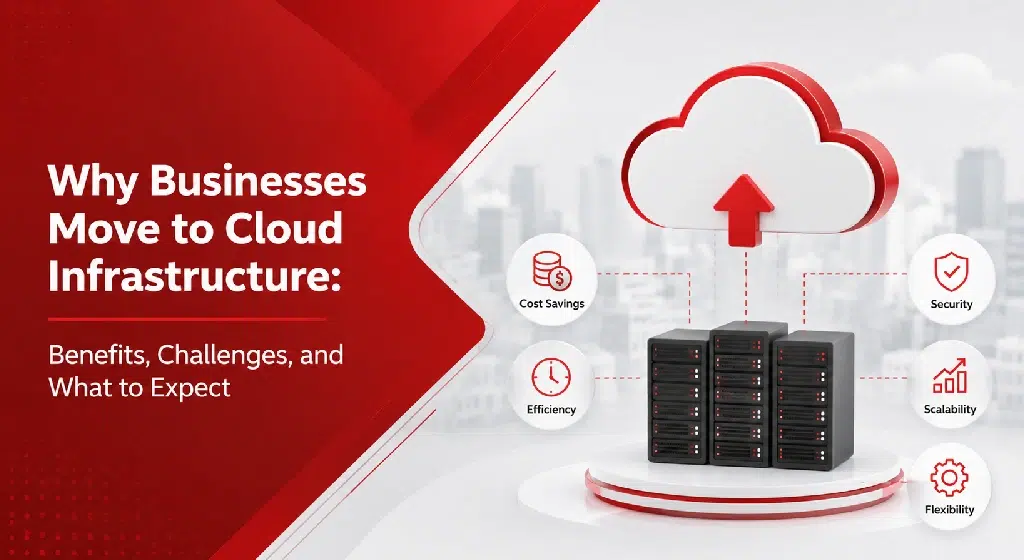
For many organizations, cloud adoption is driven by practical business needs such as scalability, accessibility, security, and operational efficiency.
This guide explains why businesses move to cloud infrastructure, what benefits they hope to achieve, and what considerations should be evaluated before making the transition.
What Is Cloud Infrastructure?
Cloud infrastructure refers to technology resources that are delivered through cloud platforms rather than maintained entirely on local hardware.
Instead of relying solely on physical servers located inside the business, organizations can access computing resources through cloud providers.
Examples include:
- cloud storage
- virtual servers
- cloud applications
- cloud networking
- cloud-based collaboration tools
For many businesses, cloud-based collaboration platforms such as Microsoft 365 play a major role in their cloud strategy, helping users access files, email, and productivity tools from virtually anywhere.
Employees access resources through secure internet connections rather than depending exclusively on local infrastructure.
Why More Businesses Are Evaluating the Cloud
Cloud adoption has accelerated because business requirements have changed.
Organizations increasingly need:
- flexibility
- remote access
- scalability
- business continuity
- simplified management
The cloud helps address many of these challenges.
The decision is often less about technology and more about supporting how the business operates.
Benefit #1: Better Accessibility
One of the biggest reasons businesses move to the cloud is access.
Traditional environments often require employees to be physically connected to office infrastructure.
Cloud environments allow employees to access resources from:
- offices
- homes
- client locations
- branch offices
- mobile devices
This flexibility supports modern work environments without requiring complex workarounds.
Benefit #2: Improved Scalability
Business growth rarely happens in a straight line.
Organizations expand.
New employees join.
Additional applications are deployed.
Infrastructure demands change.
Traditional environments may require businesses to purchase hardware in anticipation of future needs.
Cloud infrastructure offers greater flexibility.
Resources can often be adjusted more easily as requirements evolve.
This helps businesses respond more effectively to growth.
Benefit #3: Reduced Dependence on Physical Hardware
Traditional infrastructure requires businesses to manage:
- servers
- storage systems
- networking equipment
- maintenance schedules
Over time, hardware ages.
Equipment eventually requires replacement.
Cloud infrastructure reduces reliance on physical equipment located inside the organization.
While technology management never disappears completely, many businesses find cloud environments easier to scale and maintain.
Benefit #4: Stronger Business Continuity
Business continuity has become a major concern for organizations of all sizes.
Unexpected events can disrupt operations.
Examples include:
- hardware failures
- power outages
- severe weather
- facility issues
Cloud environments often support continuity by allowing employees to access resources from multiple locations.
This flexibility can reduce operational disruption.
Benefit #5: Easier Collaboration
Modern teams frequently collaborate across locations and departments.
Cloud-based platforms make it easier to:
- share documents
- work simultaneously
- communicate in real time
- access current information
Many organizations move to cloud infrastructure because collaboration becomes simpler and more efficient.
Benefit #6: Faster Deployment of New Resources
Traditional infrastructure projects often involve:
- purchasing equipment
- installation
- configuration
- testing
Cloud environments can often accelerate deployment.
Organizations gain the ability to implement new resources without waiting for physical infrastructure projects.
This flexibility supports faster business initiatives.
Benefit #7: Better Support for Remote and Hybrid Work
Remote work changed how many businesses think about technology.
Employees now expect secure access from virtually anywhere.
Cloud infrastructure helps support:
- remote workers
- hybrid teams
- traveling employees
- multi-location organizations
The workplace is no longer tied to a single building.
Technology must adapt accordingly.
Benefit #8: Security Improvements
A common misconception is that moving to the cloud automatically improves security.
The reality is more nuanced.
Cloud providers invest heavily in security infrastructure.
However, businesses remain responsible for:
- access controls
- account security
- permissions
- user behavior
When properly managed, cloud environments can provide strong security capabilities.
The key is understanding that security remains a shared responsibility.
Many organizations rely on professional managed IT services to help monitor systems, maintain security controls, and support ongoing cloud operations.
Benefit #9: Predictable Technology Planning
Traditional infrastructure often creates large periodic expenses.
Examples include:
- server replacement
- storage expansion
- hardware upgrades
Cloud adoption can make planning more predictable by shifting many technology investments toward ongoing operational models.
This often improves budgeting visibility.
Benefit #10: Supporting Future Growth
Many businesses ultimately move to the cloud because they are planning for the future.
Questions often include:
- How will we support growth?
- How will we manage additional locations?
- How will employees collaborate?
- How will we secure remote access?
Cloud infrastructure provides flexibility that helps businesses adapt as needs evolve.
Why Some Businesses Delay Cloud Adoption
Despite the benefits, not every organization moves immediately.
Common concerns include:
- migration complexity
- cost concerns
- legacy applications
- security questions
- change management
These concerns are understandable.
Successful cloud adoption requires planning rather than simply moving systems from one location to another.
Common Signs a Business May Be Ready for Cloud Infrastructure
Organizations often begin evaluating cloud solutions when:
- remote work increases
- hardware approaches end of life
- collaboration becomes difficult
- growth accelerates
- multiple locations require access
- infrastructure costs become harder to manage
These challenges are often early indicators that an organization may benefit from improved cloud capabilities. Recognizing the common signs your business needs better cloud solutions can help prioritize technology investments before operational issues grow.
Cloud Adoption Is Not All or Nothing
Another misconception is that businesses must move everything at once. In reality, many organizations evaluate both hybrid cloud and full cloud environments before determining the approach that best aligns with their operational and compliance requirements.
Many organizations adopt cloud services gradually.
Examples include:
Phase 1: Email and collaboration tools
Phase 2: File storage and sharing
Phase 3: Business applications
Phase 4: Infrastructure modernization
A phased approach often reduces disruption and improves adoption.
Questions Businesses Should Ask Before Moving to the Cloud
Before beginning a migration, consider:
- What problems are we trying to solve?
- Which systems are most critical?
- How will users access resources?
- What security controls are needed?
- What does future growth look like?
Technology decisions should support business objectives.
Final Thoughts
Businesses do not move to cloud infrastructure simply because it is newer technology.
They move because the way people work has changed.
Organizations increasingly need flexibility, scalability, accessibility, and resilience that traditional infrastructure can struggle to provide.
The cloud is not a solution to every challenge.
However, for many businesses, it creates opportunities to simplify operations, improve collaboration, and better support future growth.
The most successful cloud initiatives begin with business goals rather than technology goals.
When those goals are clearly defined, the benefits become much easier to realize.
If you’re evaluating cloud infrastructure and want guidance on planning, migration, or long-term management, contact our team to discuss your business requirements.
Frequently Asked Questions
What is cloud infrastructure?
Cloud infrastructure refers to computing resources such as storage, applications, and servers that are delivered through cloud platforms rather than relying entirely on local hardware.
Why do businesses move to the cloud?
Common reasons include improved accessibility, scalability, collaboration, business continuity, and support for remote work.
Is cloud infrastructure more secure?
Cloud providers offer strong security capabilities, but businesses remain responsible for managing access, permissions, and user security.
Do businesses have to move everything to the cloud?
No. Many organizations adopt cloud services gradually through phased migrations.
What is the biggest benefit of cloud infrastructure?
The answer varies by business, but flexibility and accessibility are often among the most significant advantages.