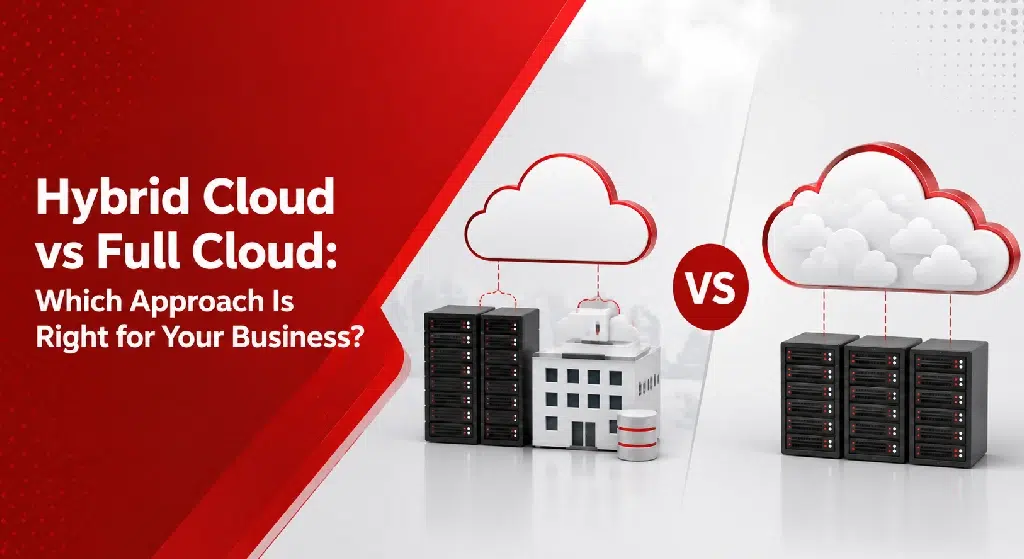
As businesses modernize their technology environments, one question frequently emerges:
Should we move completely to the cloud, or should we keep some systems on-premise?
For many organizations, the decision isn’t simply about adopting cloud technology.
It’s about determining how much of the business should move and what should stay where it is.
That’s where the discussion around hybrid cloud and full cloud begins.
Both approaches can deliver significant benefits.
Both can support growth, collaboration, and business continuity.
And both are commonly used by organizations of all sizes.
The right choice depends less on technology trends and more on business requirements.
This guide explains the differences between hybrid cloud and full cloud environments, their advantages and challenges, and how businesses can evaluate which model makes the most sense.
Understanding Cloud Deployment Models
Before comparing the two approaches, it’s helpful to understand what each model means.
Full Cloud
A full cloud environment places the majority of business systems, applications, and infrastructure in cloud platforms.
Examples may include:
- file storage
- collaboration tools
- business applications
- servers
- backups
The cloud becomes the primary technology environment.
Hybrid Cloud
A hybrid cloud environment combines cloud services with on-premise infrastructure.
Some systems remain local.
Others operate in the cloud.
Both environments work together.
Examples may include:
- Microsoft 365 in the cloud
- local file servers
- on-premise applications
- cloud backups
- hybrid identity systems
The business maintains a mix of both environments.
Why This Decision Matters
The choice affects:
- security
- performance
- accessibility
- costs
- scalability
- administration
Many of these factors are the same reasons organizations begin evaluating cloud adoption in the first place. Understanding why businesses move to cloud infrastructure can provide additional context when comparing deployment models.
What Is a Full Cloud Environment?
In a full cloud model, business technology is delivered primarily through cloud platforms.
Employees access resources through secure internet connections rather than relying on local infrastructure.
Examples include:
- Microsoft 365
- cloud storage
- cloud-hosted applications
- cloud-based collaboration
In many cases, organizations significantly reduce or eliminate traditional server infrastructure.
Benefits of a Full Cloud Environment
Simpler Infrastructure
Businesses often reduce the need to maintain:
- physical servers
- storage hardware
- local infrastructure
This can simplify management.
Better Support for Remote Work
Employees can access resources from virtually anywhere.
This flexibility supports:
- remote teams
- hybrid work
- mobile users
Easier Scalability
Adding users and services often becomes more straightforward.
Cloud resources can generally expand as business needs grow.
Faster Deployment
New systems and resources can often be deployed more quickly than traditional infrastructure projects.
Reduced Hardware Dependencies
Organizations become less dependent on server replacement cycles and hardware maintenance.
Challenges of a Full Cloud Environment
While attractive, full cloud environments are not perfect.
Legacy Application Compatibility
Some older applications may not function effectively in cloud environments.
Internet Dependence
Access typically relies on internet connectivity.
Reliable connectivity becomes critical.
Migration Complexity
Moving entirely to the cloud often requires planning and change management. Understanding how long a cloud migration takes can help organizations set realistic expectations and create a phased transition plan.
Operational Changes
Employees may need to adapt to new workflows and processes.
What Is a Hybrid Cloud Environment?
Hybrid cloud combines cloud services with local infrastructure.
Rather than moving everything immediately, organizations keep certain systems on-premises while adopting cloud technologies where appropriate.
This model is often viewed as a bridge between traditional infrastructure and full cloud adoption.
Benefits of a Hybrid Cloud Environment
Flexibility
Businesses can place workloads where they make the most sense.
Some systems stay local.
Others move to the cloud.
Gradual Migration
Organizations do not need to move everything simultaneously.
Cloud adoption can occur in phases.
Legacy System Support
Applications that require local infrastructure can remain operational.
Reduced Disruption
Businesses often experience fewer operational changes compared to large-scale migrations.
Greater Control Over Certain Systems
Some organizations prefer maintaining local control over specific workloads or applications.
Challenges of a Hybrid Cloud Environment
Hybrid environments offer flexibility but introduce complexity.
More Systems to Manage
IT teams often manage:
- cloud platforms
- local infrastructure
- integrations between environments
This can increase administrative effort.
Many organizations use managed IT services to help oversee hybrid environments, maintain security, and support both cloud and on-premise systems.
More Complex Security
Security controls must extend across both environments.
Visibility becomes more important.
Additional Maintenance Requirements
On-premise systems still require:
- updates
- monitoring
- hardware support
The cloud does not eliminate infrastructure responsibilities.
Hybrid Cloud vs Full Cloud: Side-by-Side Comparison
|
Category |
Hybrid Cloud |
Full Cloud |
|
Infrastructure |
Mix of cloud and local systems |
Primarily cloud-based |
|
Scalability |
Moderate to high |
High |
|
Remote Access |
Good |
Excellent |
|
Legacy Application Support |
Strong |
Depends on application |
|
Hardware Requirements |
Some local infrastructure |
Reduced infrastructure |
|
Management Complexity |
Higher |
Often simpler |
|
Migration Speed |
Gradual |
Larger transition |
|
Flexibility |
High |
High |
|
Operational Change |
Lower |
Higher |
Neither approach is universally better.
The best fit depends on business goals.
When Hybrid Cloud Often Makes Sense
Hybrid cloud may be appropriate when:
- legacy applications remain important
- compliance requirements exist
- infrastructure investments are relatively new
- gradual migration is preferred
- business disruption must be minimized
Many organizations begin their cloud journey through a hybrid model.
When Full Cloud Often Makes Sense
Full cloud environments may work well when:
- remote work is common
- collaboration is a priority
- aging infrastructure needs replacement
- scalability is important
- cloud-native applications are already being used
Businesses seeking simplicity often gravitate toward full cloud environments.
The Most Common Mistake Businesses Make
Many organizations assume cloud decisions are purely technical.
In reality, they are operational.
The right questions include:
- How do employees work?
- What applications are critical?
- What growth plans exist?
- How important is remote access?
- What security requirements must be met?
Technology should support business objectives.
Not the other way around.
Do Most Businesses Go Fully Cloud Immediately?
Usually not.
Many organizations follow a progression similar to:
Phase 1: Cloud email and collaboration
Phase 2: Cloud storage and file sharing
Phase 3: Cloud-based business applications
Phase 4: Infrastructure modernization
Over time, hybrid environments may evolve into full cloud environments.
But not always.
Some organizations continue operating successfully with hybrid models for years.
Questions to Ask Before Choosing
Before deciding between hybrid cloud and full cloud, consider:
- Which applications are critical?
- What infrastructure currently exists?
- How mobile is the workforce?
- What security controls are required?
- What does future growth look like?
The answers often clarify the best path forward.
Businesses experiencing collaboration challenges, infrastructure limitations, or growing remote-work demands may already be seeing the signs they need better cloud solutions.
Final Thoughts
Hybrid cloud and full cloud are not competing technologies.
They are different approaches to solving business challenges.
Hybrid cloud provides flexibility and gradual adoption.
Full cloud emphasizes scalability, accessibility, and simplified infrastructure.
The right choice depends on how your organization operates today and where it wants to go in the future.
For many businesses, the question is not whether cloud adoption will happen.
It is determining the pace and strategy that best supports long-term growth.
If you’re evaluating a hybrid or full cloud strategy and need guidance on migration planning, infrastructure modernization, or cloud management, contact our team to discuss your business goals.
Frequently Asked Questions
What is the difference between hybrid cloud and full cloud?
Hybrid cloud combines cloud services with on-premise infrastructure, while full cloud environments rely primarily on cloud-based resources.
Is hybrid cloud more secure than full cloud?
Security depends largely on implementation, management, and controls rather than the deployment model itself.
Why do businesses choose hybrid cloud?
Many organizations use hybrid cloud to support legacy applications, reduce disruption, and migrate gradually.
Is full cloud less expensive?
Costs vary significantly depending on infrastructure, applications, and operational requirements.
Can businesses start with hybrid cloud and move to full cloud later?
Yes. Many organizations adopt cloud services gradually before expanding their cloud footprint over time.